



Popular Articles


Most multichannel outreach runs on a timer: an email on day one, a LinkedIn request on day three, a call on day five, sent to everyone on the list. Alex Shartsis, co-founder and CEO of Skip AI, runs it on signals instead. A prospect who fits the ICP and really opened the email gets the LinkedIn request and goes to the dialer. Everyone else stays in the email sequence until they give you a reason to reach further.
Signal-based multichannel outreach means you spend LinkedIn requests and calls only on ICP prospects who showed a verified signal, such as a bot-filtered email open.
The difference shows up in acceptance rates. "We've seen people's acceptance rate go from twelve percent to eighty to ninety percent because they emailed them first," Alex told Kinner Sacchdev on Edbound With Kinner.
That only works when three things hold: your emails reach the inbox, your open data is accurate, and your list is built from real signals. Before Skip AI, Alex had exits at Drawbridge and TripIt, ran corporate development at Opendoor and built PerfectPrice. Here is how he builds the system.
Why timer-based multichannel outreach wastes your scarcest channels
Email scales and LinkedIn does not. You can send thousands of emails a week, but Alex puts the realistic LinkedIn ceiling at 50 to 100 connection requests a week. Phone time is just as limited when reps make hundreds of calls a day.
Kinner saw the gap in Edbound AI's own first campaigns. Cold email returned 7 replies from 8,000 sends. LinkedIn returned 7 replies from 250 invites.
Blasting does not fix the email side. Alex describes the default playbook as grabbing 8,000 addresses from Apollo or ZoomInfo and sending 8,000 emails. "That strategy doesn't work as well as it used to. And it kind of doesn't work at all because everybody's doing that." Inbox providers filter those emails, and the people who do see them press delete.
So the real question is not which channel wins. It is how to spend LinkedIn and phone capacity only on people your email has already warmed. That is the difference between a timer-based outbound sales sequence and a signal-triggered one.
As Alex puts it: "The job to be done is not send eight thousand emails. The job to be done is get customers."
Step 1: Get deliverability right before you add channels
Every later step depends on the email landing. If it goes to spam, there is no open to act on.
The most common mistake Alex sees is sending cold email from the company's primary domain through a tool like HubSpot. It works at first because the domain and account are warm. "It's gonna go into the inbox until it doesn't."
Then a few spam reports land. "It doesn't take many people to mark it as spam to put your entire domain either in the spam folder or on a blacklist," he said. Getting out "can be done, but it takes months."
The damage spreads past sales:
- A 200-person company Alex spoke with was sending sales email from HubSpot on its real domain. Its customers reported that support emails were landing in spam.
- At another company, one salesperson connected his account to HubSpot and sent thousands of emails in a sequence. Google locked the company out of email, calendar and Drive, and it took a couple of days to get back to work.
Separate sending infrastructure fixes this only if it is set up properly. Alex warns that skipping warmup or DNS configuration makes results worse, and teams then wrongly conclude email has stopped working. Google publishes the baseline requirements in its email sender guidelines. For the wider sending system, see Alan Dsouza's breakdown of why your cold email outreach strategy is only one third of what converts.
Content is the second half of deliverability. Alex lists three ways an email dies:
- Spam filters catch it. Words like "guarantee" and other spam-like phrasing send it to the spam folder.
- The provider refuses to send it. Google or Microsoft decides it looks like spam and never delivers it.
- A person deletes it. It reaches the inbox but reads like a templated or AI-written email.
Only the third failure leaves a trace you can learn from. The first two stay invisible unless you watch your open data, which is the next step.
Step 2: Make your cold email open rate trustworthy before you act on it
A raw open is a weak signal, which is why most guides tell you to ignore open rates. As Alex puts it, Apple Mail "opens every single email," and Apple's Mail Privacy Protection setting exists to stop senders from seeing whether a message was opened. If half your list uses Apple Mail, half your opens can be machines.
Skip AI answers this with what Alex describes as a 25-step, AI-based bot filtering system that scores every event for the chance it came from a bot. He calls it "very strict" on purpose. The point is to make decisions, not to feel good about a dashboard.
He argues most tools have the opposite incentive. "I'd rather you churn as a customer and know the truth, than like lie to you, but keep you around not being successful for longer."
What filtered numbers look like, according to Alex:
- Skip AI's average open rate runs at 38 to 39%.
- His best campaigns have reached 80%.
- A campaign under 20% on the platform is rare and "means like you really screwed something up."
- The 200-person team sending from HubSpot on its primary domain was at 16%.
These are Skip AI's own figures, not an industry benchmark. Use them as a reference point for bot-filtered data.
When to track opens: keep open tracking on for new campaigns, because replies are too rare to tell you whether you are reaching inboxes. Once your subject lines are proven, Alex says it is fine to turn tracking off. At low to medium volume he would still keep it, because it feeds the next step.
One rule keeps this sound: an open never qualifies a prospect on its own. ICP fit comes first. A filtered open from an ICP account tells you who to reach next.
Step 3: Trigger LinkedIn requests and calls from verified opens
This is the core of the system. The email does the warming. LinkedIn and the phone convert the people it warmed.
The trigger works like this:
- Send a relevant email to an ICP-fit prospect.
- If a filtered open comes back, send a LinkedIn connection request.
- Push the same prospect to your dialer for a call. Alex names Nooks as one example.
- If there is no open, keep them in the email sequence and look at your subject line.
Why it lifts acceptance: the prospect has already seen your name. "Now they're connected to somebody in their industry that wouldn't have connected with them before just because the name sounded familiar or the brand sounded familiar," Alex said. That familiarity is what moved acceptance from 12% to 80 to 90% for the teams he described.
The same effect carries into calls. A prospect who has seen your name in their inbox has "a slightly better chance of picking up the phone." Alex's estimate is that a 20 or 30% better chance of a conversation "is a huge impact" when a rep is making hundreds of calls a day. Mentioning the call in the email can help too.
Because LinkedIn is capacity constrained, the open filter is what makes this work at scale. You stop spreading 100 weekly requests across the whole list and spend them on people who already know your name.
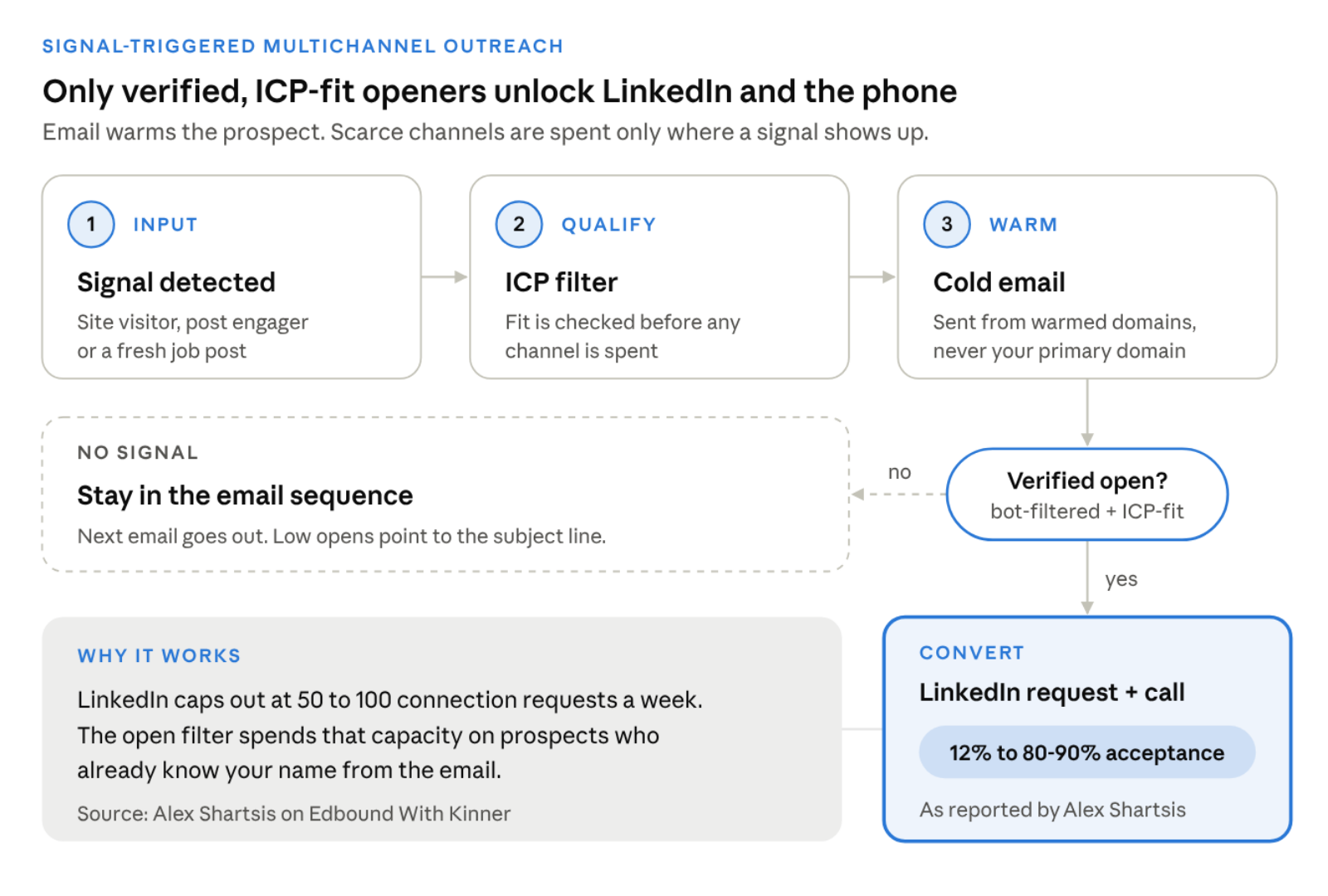
The email warms the prospect; only a verified open from an ICP-fit account unlocks the scarce channels.
The LinkedIn connection request message: short beats personalized
Alex is blunt about what kills LinkedIn outreach: long, over-personalized, obviously AI-written messages. He described one that opened briefly "and then it went on for three screens about stuff I don't care about."
His default connection request message is close to this:
"Hey, I just wanted to connect. Is there anything you want to talk about?"
If they reply that they are interested in what you do, book the meeting. Do not answer a fresh connection with an essay about your company.
You can be more direct when the signal is stronger. For someone who engaged with your content, Alex's version is:
"Hey, I saw you commented on my last post about GTM engineering. Do you want to have a conversation?"
There is a second payoff. Every accepted request grows your network, and connections are more likely to see your posts. For a startup in a new category, where buyers do not yet know they have the problem, that is how you frame the problem your way. Laura Erdem's signal-based social selling strategy goes deeper on LinkedIn as a qualification system.
Where signals come from: website visitors, post engagers and job posts
Signals decide who enters the sequence at all. Alex separates them from old-style intent data, which is often a cookie from a past search. At Drawbridge, an ad tech company, he saw people keep that cookie for a month after they had already booked their flights, hotel and rental car. Signals are fresher and more specific.
He uses three:
Website visitors. This is the one Alex says everyone should run. "Even if you only have 10 or 20 visitors on your website a day and you can identify five to ten of them, somebody's gonna be in your ICP." Skip AI uses email mainly to follow up with people who visited the site or engaged with the brand, much like retargeting. To identify website visitors, Alex points to tools such as RB2B, Clay and Apollo, which plug into the sending platform. On privacy, his view is that this is now accepted practice, unless you are, say, a nonprofit advocating for internet privacy. Adam Robinson, whose RB2B is one of the tools Alex mentions, shared his founder-led marketing strategy on the show.
Post engagers. Skip AI has a Chrome extension, not yet released, that pulls everyone who interacted with a LinkedIn post, yours or a competitor's. Alex filters that list to his ICP in Claude, then sends outreach that references the post.
Company signals. A job post saying a company is moving from Salesforce to HubSpot and hiring a HubSpot developer tells you it is in market for HubSpot help. Check freshness: if the post is down or three months old, the move is probably done. Alex knows one company that emails three people a week and books three meetings, because each email is that relevant. For deeper playbooks, see Martin Markov on buying intent signals and Tim Yakubson's signal based outbound system.
At the other extreme is a high-value offer. One Skip AI customer, a well-known startup backed by Andreessen, hosts dinners for C-level ICP buyers city by city. It does not blast invites. It invites the right people, and its brand gives it the credibility to get a yes.
How much multichannel outreach volume you actually need
Most Skip AI customers have between a couple of hundred and 10,000 companies in their whole market. Send a million emails a month to that market and you simply run out of market.
Alex's math: reach about 1,000 people with five emails a month, and you work through the ICP contacts at 10,000 companies every three to six months. That is why Skip AI keeps conservative sending limits on both email and LinkedIn.
Expect to iterate. Alex compares it to a first Google Ads campaign: the first version is never the one with your lowest acquisition cost. Diagnose in order:
- Low opens: fix the subject lines.
- Opens but no replies: fix the offer.
Multichannel outreach only works when your channels feed each other
Kinner called this the biggest takeaway of the conversation. No single channel is the magic bullet, and channels only pay off when they are connected.
Two examples from Skip AI:
- Paid search was bringing the right people to the site, visible through visitor identification, before they filled in a form. Dropping them because they did not book a demo wastes the click. Following up by email does not.
- Email fails without a presence behind it. Prospects look you up, and with no LinkedIn presence and a weak website, "they're gonna be like, Delete... I don't know this guy." With relevant LinkedIn content, a decent website and Google retargeting, a visit from an email can come back later as a booked demo.
Alex also warns against chasing every new tactic. At Skip AI, LinkedIn content, LinkedIn outreach and website visitor follow-up are the proven core. Reddit, paid search and LLM and SEO optimization sit in an experimental bucket until they earn more budget. And because founders are flooded with AI email about AI email, Skip AI does not lean on cold email to sell cold email. HeyReach faced the same problem; Vukasin Vukosavljevic explains how inbound marketing worked for an outbound product.
Podcasts belong in the mix too. Alex counts appearances like this one as organic traffic and SEO value that feed the same system.
Multichannel outreach FAQ
What is a good cold email open rate?
It depends on how opens are counted. On Skip AI's own bot-filtered data, Alex Shartsis says the average is 38 to 39%, and anything under 20% points to a broken setup. Tools that do not filter bots can show higher numbers because Apple Mail opens emails automatically.
Is cold email or LinkedIn better for outreach?
Neither on its own. LinkedIn reliably delivers but caps out at about 50 to 100 requests a week. Email scales but gets filtered. Alex uses email to warm prospects, then sends LinkedIn requests to the ones who opened.
When should you send a LinkedIn connection request after a cold email?
After a verified, bot-filtered open from a prospect who fits your ICP. Alex reports acceptance rising from 12% to 80 to 90% when prospects were emailed first.
Should you send cold email from your main domain?
Alex advises against it. A handful of spam reports can push the whole domain into spam or onto a blacklist, which takes months to fix and can hit support and transactional email too.
I use Clay. What should run the outreach?
Keep enrichment and signals in Clay, Apollo or ZoomInfo, and hand the list to a sending layer that manages deliverability and LinkedIn limits. In the setup Alex describes, enrichment runs in Claude over MCP, connected to tools like Apollo or ZoomInfo, and the result passes to Skip AI for delivery. Yash Tekriwal's guide to cold outreach that converts covers the Clay side.
What to do next
Start with the parts you control this week:
- Move cold email off your primary domain, and set up the new domains properly before you send.
- Check that your open data filters out bot opens. If it cannot, do not trigger anything from it.
- Turn on website visitor identification and email the ICP visitors.
- Route verified openers to a LinkedIn request and your dialer.
- Keep LinkedIn messages short, and save the direct ask for people who engaged with you.
Then make sure the right people are arriving at your site in the first place, and that they find something worth their time when they look you up. Edbound AI builds podcast and resource center hubs that turn your expertise into content your ICP finds and returns to. See how podcast-led growth works.