

How Product-Led Growth Generated $1B+ in SaaS Revenue — Wes Bush on Building the Product-Led Growth Playbook from Founder-Led Sales to AI-Powered PLG
.png)
.jpg)
Popular Articles
.jpg)
.jpg)
.jpg)
Most SaaS companies don’t fail because their product is bad.
They fail because distribution, activation, and focus break before scale.
In this episode of Edbound With Kinner, Wes Bush explains how Product-Led Growth (PLG) evolved from a simple idea — “let users try before they buy” — into a full-stack growth system responsible for $1B+ in SaaS revenue across hundreds of companies.
Wes breaks down:
- Why founder-led sales is often the correct starting point
- How PLG actually emerges after product–market fit
- Why most PLG attempts fail due to shallow “free trial” thinking
- And how AI is finally making real PLG execution possible at scale
This episode is a blueprint for founders navigating:
- Early traction vs scalability
- Sales-led vs product-led debates
- Complex or enterprise SaaS constraints
- AI-driven onboarding and activation
Meet the Guest
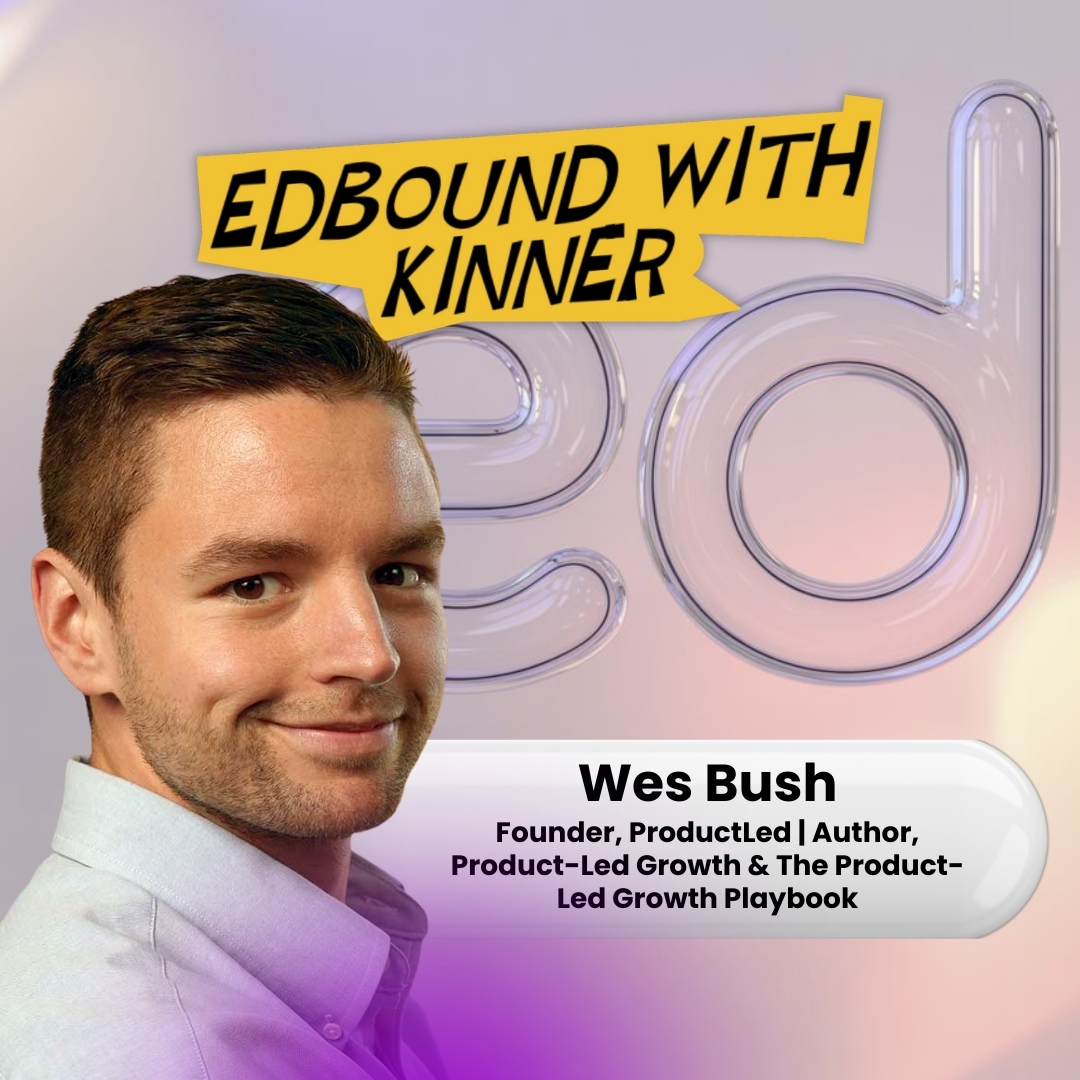
Wes Bush
Founder, ProductLed | Author, Product-Led Growth & The Product-Led Growth Playbook
Wes Bush is one of the most influential voices in Product-Led Growth. Through ProductLed, he has helped SaaS companies generate over $1B+ in self-serve revenue by redesigning how products attract, activate, and convert users.
Wes is best known for:
- Defining the Product-Led Growth framework
- Helping companies transition from sales-led to PLG
- Teaching teams how to design aha moments, activation systems, and expansion loops
- Simplifying PLG for complex and enterprise SaaS
His work sits at the intersection of product strategy, go-to-market execution, and now AI-powered onboarding systems.
Connect with Wes Bush
- Twitter (X)
- Website: ProductLed
- Books: Product-Led Growth, The Product-Led Growth Playbook
Why Product-Led Growth Became a $1B+ Revenue Engine
When asked why Product-Led Growth has worked so well at scale, Wes is clear that PLG didn’t succeed because it was a cheaper acquisition model or a clever alternative to sales. It worked because it fundamentally changed how trust is built between a product and a buyer. In a world where buyers are overwhelmed with options and skeptical of marketing claims, PLG removes the need for belief upfront. Instead of asking prospects to trust messaging, decks, or demos, it lets them experience real value before making a decision. Across hundreds of companies Wes has worked with, the pattern is consistent: when users reach value on their own terms, conversion becomes a natural next step rather than a forced outcome.
What many founders misunderstand is that PLG is not about “giving things away.” Wes emphasizes that the companies generating real revenue through PLG are extremely intentional about what they let users experience early. The product becomes the proof. When that proof is clear and fast, sales cycles compress, expansion becomes easier, and growth compounds. That is how PLG scaled from a startup tactic into a billion-dollar growth engine.
Is Founder-Led Sales the Right Starting Point Before PLG?
One of the most counterintuitive insights Wes shares is that starting with Product-Led Growth is often a mistake. In the early stages, founder-led sales is not a liability—it is an advantage. Founders who sell their own product gain an irreplaceable understanding of customer language, objections, internal politics, and buying anxiety. Wes explains that PLG only works when a company deeply understands who it is for and why that audience buys. Founder-led sales is often the fastest way to acquire that clarity.
Many teams rush into PLG hoping to skip uncomfortable conversations with customers. According to Wes, this almost always results in shallow free trials that attract users but fail to activate them. The companies that successfully transition to PLG do so after they’ve seen repeatable patterns in sales conversations. PLG doesn’t replace learning—it scales what you already understand. When founders try to invert that order, growth stalls.
Why Most Product-Led Growth Attempts Fail in Practice
When the host probes why so many PLG initiatives underperform, Wes points to a common misconception: companies confuse access with value. Offering a free trial or freemium plan does not automatically create a product-led motion. In fact, many products expose users to complexity before they ever experience success. Wes explains that this creates cognitive friction at the worst possible moment—when a user is still deciding whether the product is worth their time.
What separates successful PLG companies is restraint. Instead of showcasing everything the product can do, they focus on guiding users toward one meaningful outcome. Wes stresses that PLG failure is rarely a pricing issue; it’s almost always an activation issue. If users don’t feel progress quickly, no amount of onboarding emails, tooltips, or sales follow-ups can compensate.
How Focus Determines Whether PLG Scales or Breaks
A recurring theme in Wes’s answers is the danger of trying to serve too many audiences at once. When asked about scaling PLG, he emphasizes that focus matters more than volume, especially in the early and mid stages. Companies that chase multiple ICPs simultaneously dilute their product experience. The result is what Wes memorably describes as “weak Gatorade”—a solution that sort of works for everyone but truly resonates with no one.
Wes explains that successful PLG companies pick a narrow audience and design the product around that user’s specific success definition. This doesn’t mean other users are excluded, but it does mean product decisions are made with one clear persona in mind. Over time, that focus creates momentum, referrals, and organic expansion. PLG compounds when clarity exists; it collapses when teams try to be everything to everybody.
Can Product-Led Growth Work for Complex or Enterprise SaaS?
When the conversation shifts to enterprise and mission-critical software, Wes makes an important distinction: PLG does not mean removing humans from the process. In complex SaaS—ERP systems, infrastructure platforms, regulated industries—buyers don’t want full self-serve. They want safety, clarity, and reduced risk. Wes reframes PLG in these contexts as “serve before you sell,” not “sell without sales.”
He explains that enterprise PLG often takes the form of guided experiences rather than open trials. Sandboxes, scenario-based demos, education-led evaluations, and controlled pilots all allow buyers to understand value without committing upfront. In these cases, sales teams don’t disappear—they become guides who help prospects interpret value. PLG and sales are not opposing forces; they are complementary roles in reducing uncertainty.
Why Education Is Central to Product-Led Growth
Throughout the episode, Wes repeatedly returns to education as a core growth lever. Before buyers purchase, they need to understand not just the product, but the problem space. Wes explains that many SaaS purchases stall not because of pricing or features, but because buyers are unsure whether they are even approaching the problem correctly.
This is why education—through books, long-form content, courses, and communities—is not marketing fluff but a foundational PLG mechanism. Education builds internal conviction before a sales conversation ever happens. By the time a prospect engages with a product or a salesperson, they already believe the approach makes sense. PLG works best when belief precedes action.
How AI Is Changing the Execution of Product-Led Growth
When asked about the future of PLG, Wes is optimistic but grounded. AI, in his view, doesn’t replace strategy—it removes execution friction. He explains that many PLG systems historically failed not because they were conceptually wrong, but because they were too hard to implement manually. AI now makes it possible to personalize onboarding, adapt flows in real time, and guide users dynamically based on intent and behavior.
However, Wes is careful to draw a line. While AI can automate setup, education, and guidance, the final mile—trust, internal politics, and decision-making—remains human. The companies that win will be those that use AI to accelerate understanding without eroding authenticity. PLG becomes more powerful when AI amplifies clarity, not when it replaces relationships.
The One Rule Pre–$1M ARR Founders Must Follow
In the closing moments, Wes distills his advice for early-stage founders into a single principle: founder–product–market fit. He explains that in a world where building software is easier than ever, the real differentiator is commitment. Founders who genuinely care about the problem they’re solving persist longer, learn faster, and make better decisions under pressure.
PLG systems, AI tooling, and growth frameworks only work when the founder’s motivation is aligned with the problem itself. Without that alignment, even the best strategies eventually decay. According to Wes, the companies that reach meaningful scale are built by founders who would work on the problem even if the outcome were uncertain. That conviction becomes the hidden engine behind sustainable growth.
What You’ll Discover in This Episode
- How Product-Led Growth has generated $1B+ in SaaS revenue
- Why founder-led sales is often the best starting point (and when to move beyond it)
- The 9 core components of the Product-Led Growth system
- How Wes discovered PLG while scaling Vidyard
- What the first “aha moment” should look like in any product
- Why focus beats scale in early-stage SaaS
- How to design PLG for complex and enterprise software
- Why “serve before you sell” is the new growth rule
- The role of education, content, and community in PLG
- How AI is changing onboarding, activation, and expansion
- The one rule every pre–$1M ARR founder must follow
- Why founder–product–market fit matters more than strategy
Watch or Listen to the Episode
Watch on YouTube
Listen on Spotify
Subscribe to Edbound With Kinner for deep conversations on:
- Product-led growth
- AI-powered GTM systems
- Founder playbooks that scale
Episode Timestamps
- 00:00 Intro
- 01:34 Meet Wes Bush, Founder - ProductLed & PLG Thought Leader
- 02:15 How Product-Led Growth Generated $1B+ in SaaS Revenue
- 04:55 The Birth of Product-Led Growth at Vidyard
- 06:39 How to Decide What Features to Give Away for Free
- 08:33 The Core Components of the Product-Led Growth System
- 11:02 Defining the First “Aha Moment"
- 13:18 Why Focus Beats Scale in Early-Stage PLG
- 15:41 Can Product-Led Growth Work for Complex & Enterprise SaaS?
- 20:44 Serve Before You Sell – De-Risking the Modern Buyer
- 24:20 AI, Chatbots, and Activation in Product-Led Growth
- 28:11 Building Community as a Product-Led Growth Engine
- 31:35 When to Switch From Sales-Led to Product-Led Growth
- 40:17 One Rule Pre–$1M ARR Founders Must Follow
Key Takeaways
- PLG is a system, not a pricing model
- Founder-led sales often precede great PLG
- A strong “aha moment” beats more features
- Education reduces friction better than persuasion
- AI will compress onboarding, not eliminate strategy
- The best PLG products serve before they sell
About the Podcast
Edbound With Kinner is where founders, operators, and GTM leaders unpack real systems that scale companies — not aspirational soundbites.
Hosted by Kinner N Sacchdev, Co-founder & CEO of Edbound AI and Knorish, the show explores:
- Product-led growth
- AI-driven GTM
- Educational content as a growth engine
- Scalable SaaS playbooks
Real operators. Real systems. No fluff.