

The Content-Led GTM Strategy Natalie Marcotullio Used to Scale Navattic
.png)
.jpg)
Popular Articles
.jpg)
.jpg)
.jpg)
TL;DR
- A content-led GTM strategy only compounds when every asset is unique, valuable, and built on proprietary data or customer moments competitors cannot replicate.
- Publishing more is not the answer at low domain authority. Building fewer, stronger pillar assets is.
- One annual research report or one customer roadshow can fuel a full year of blogs, LinkedIn posts, YouTube cuts, and webinars.
- Customer-only events of 15 to 20 people produce more compounding content and trust than any prospect-facing webinar.
- Brand cohesion is the next moat. Siloed AI optimizations are quietly fragmenting messaging across channels for most B2B teams.
Most B2B brands publish more content every year and generate less pipeline from it. The math is broken, and Navattic figured out why. The discipline of a content-led GTM strategy is not about volume. It is about building fewer, stronger pillar assets that earn the right to be repurposed across every channel for the next twelve months.
That is the thread running through every play Natalie Marcotullio described on the Edbound With Kinner podcast with host Kinner Sacchdev. Natalie is the head of growth and product marketing at Navattic, a two-time first marketing hire, and one of the sharpest practitioners of content compounding in B2B SaaS today. She joined Navattic when it was an 8-person startup and built the content engine that now anchors the category. You can listen on Spotify, watch on YouTube, or read the full breakdown below.
What is a content-led GTM strategy? A content-led GTM strategy uses original content as the primary engine for demand generation, sales enablement, and category authority. Unlike outbound or paid motions, it compounds over time because each pillar asset feeds multiple channels, builds trust before the sales conversation, and creates durable inbound demand.
The Filter Every Content-Led GTM Strategy Needs: Unique and Valuable
Natalie has one filter she applies to every campaign, every product launch, every blog post. Two questions. Is it unique? Is it valuable?
Unique does not mean inventing a category nobody has heard of. It means adding something to the conversation that only you can add. Original data. A customer story nobody else has access to. A specific pain point you have heard ten times that the rest of the market is still ignoring.
"Have I seen this from other places in the market? Are we clearly just copycatting?"
Valuable is the harder test. Most marketing content fails it. The question is whether the asset makes the reader's day-to-day job easier, not whether it makes the brand look impressive.
The filter is brutal because it kills most ideas before they ship. That is the point. A content-led demand generation B2B strategy at a low-authority brand cannot afford filler. Every published asset is a vote for what the brand stands for. The same discipline shows up in Rand Fishkin's startup marketing strategy, built on the same conviction that originality is the only durable moat.
Pillar Content Beats Content Calendars: The GTM Engine Behind Navattic's Annual Report
Most B2B teams plan content the wrong way. They build a calendar, fill it with topics, then pressure the team to produce. The output looks busy. The pipeline looks the same as it did six months ago.
Natalie's team does the opposite. They build one or two enormous pillar assets per year, then spend the rest of the year extracting value from them.
The flagship pillar at Navattic is the State of the Interactive Product Demo report. It analyses the top one, ten, and twenty-five percent of demos built on the platform. It answers the questions the market keeps asking. How long should a demo be? What tone works best. Where should demos sit on a website? The data is proprietary. No competitor can build the same report.
"We just followed Navattic best practices from their report."
That quote came from one of Navattic's customers, said in front of a room of other customers. It is the highest compliment a pillar asset can earn. The report stops being marketing material and becomes the reference document for the category.
That is the difference between content production and a pillar content GTM engine. The first measures effort. The second measures gravity.
The Repurposing System Behind a Compounding Content-Led GTM Strategy
A pillar asset is wasted if the brand only uses it once. The compounding only kicks in when the same source material gets broken down, repackaged, and redistributed across every channel the audience uses.
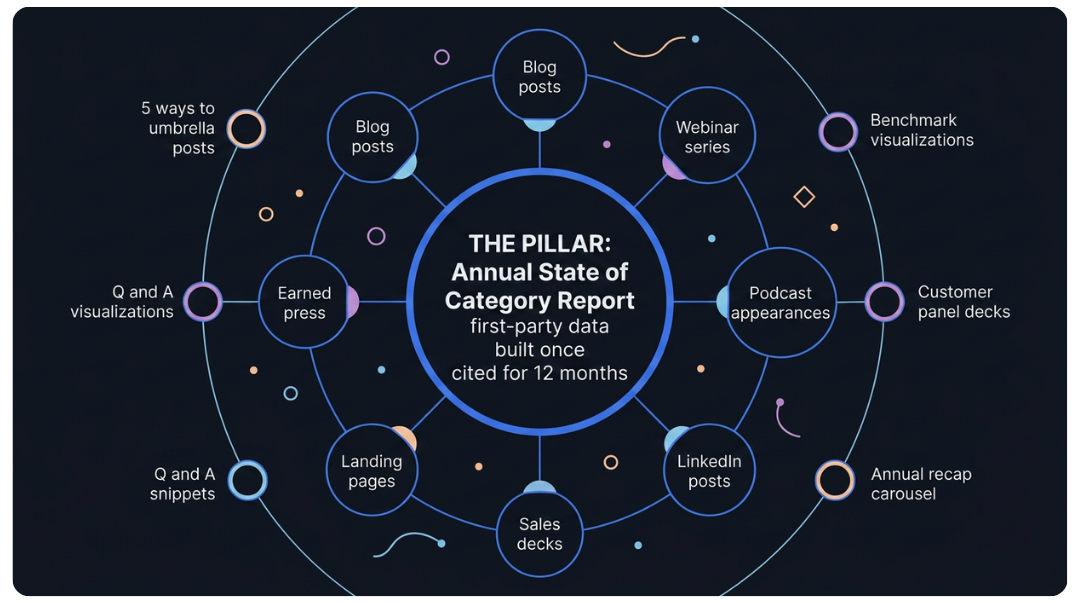
Natalie's system is mechanical and worth copying.
- Annual report becomes the source document
- Report becomes five to eight blog posts on specific findings
- Report becomes a webinar
- Report becomes a podcast tour for the spokesperson
- Report becomes thirty plus LinkedIn posts cut from the data
- Report becomes social clips and short videos
The same logic applies to the customer roadshow events Navattic runs. Each event includes a fifteen-minute "show and tell" segment where a customer explains how they actually use the product. Those segments get recorded. They become YouTube videos. They become blog posts. They become LinkedIn clips.
Then comes the second compounding layer. Five customer show-and-tells about website demos become a single blog post titled "Five ways to use interactive demos on your website." One source asset. Two layers of content output. That is the compounding curve a content-led inbound system is supposed to produce.
The Customer-Only Roadshow That Outperforms Every Webinar
Most B2B field marketing is built for prospects. Conference booths, sponsored dinners, prospect-heavy webinars. The output is short-term pipeline and forgettable content.
Natalie's roadshow inverts that. The first two hours of every event are customers only. No prospects. No exceptions. Consultants who work with Navattic customers can attend. Anyone in a buying conversation cannot.
The constraint feels counter-intuitive. Why fill a room with people who already pay you when you could fill it with people who might. The answer is that customers behave differently when they are not being sold to or sold around.
"They don't want to feel like they are being used to sell."
The output of those rooms is what drives the engine. Customers swap real tactics. They admit what is not working. They give the kind of unfiltered show-and-tell that no prospect-facing event ever produces. That content compounds for the rest of the year.
Natalie also caps attendance deliberately. Fifteen to twenty people is the sweet spot. Thirty is the ceiling. Larger rooms feel more impressive on a slide and produce worse conversation, worse content, and worse customer expansion signals. Intimacy is the asset.
Spotify Embed Insert Here
The Community Layer That Makes Content-Led Demand Generation Compound
Roadshows produce magic in the room. The problem with every in-person event is that the magic dies the moment people leave. Most B2B brands run an event, gather business cards, send a thank-you email, and lose energy within a week.
Navattic built a portal to solve that. After every event, attendees are invited into an online space where they participate in challenges, beta tests, and discussion threads. They earn points. They redeem points for gifts. They post questions like "how is anyone using demos on their pricing page" and get real answers from other customers.
Inside the portal, three behaviours drive most of the activity:
- Beta tests and feedback challenges that earn customers product credit
- Peer discussion threads on specific use cases
- A live calendar of upcoming events and webinars
The community is the connective tissue between every other asset. The report sends people to the portal. The roadshow sends people to the portal. The blog sends people to the portal. The portal sends people back to the next report and the next roadshow. The same compounding logic shows up in Kathleen Booth’s community-led growth playbook at Pavilion.
This is the layer most content-led GTM teams skip. They build pillars. They repurpose. They never give the audience a place to stay between assets. The pipeline that should have compounded leaks out instead.
Got it. Here's the mid-article CTA rewritten in that exact format.
The Advisor Program That Doubles as Distribution
One more layer worth borrowing. Navattic pays a group of fifteen senior B2B marketers a monthly retainer as advisors. They get real advice every month. The advisors also help promote Navattic when there is a major launch.
The structure matters. Most companies treat advisors as equity grants or one-off paid posts. Both fail. Equity feels too distant to drive monthly attention. One-off posts feel transactional and read that way. Monthly retainers create monthly relationships, which create monthly compounding distribution.
This is the same logic Adam Robinson’s founder-led marketing playbook at RB2B runs on. Build one strong asset, in this case the advisor relationship, and let it compound across content, credibility, and reach.
The Skill That Will Separate GTM Leaders in the AI Era
Natalie's view on the AI shift is the most useful warning in the whole conversation. The risk is not that marketing teams will fail to adopt AI. The risk is that they will adopt it badly.
"GPTs aren't really talking to each other. So if you're having one GPT over here that's optimizing your ads for certain copy and keeps optimizing, keeps optimizing, and you have one over here that's optimizing your website and they're not communicating, then you might end up with totally different messaging on your website than your ads." - Natalie Marcotullio, Navattic
Every channel optimization in isolation is a small win. Stacked across a brand, those small wins fragment the positioning. The ads start saying one thing. The website starts saying another. The sales deck drifts. The cohesion that took years to build erodes in months.
The skill that separates GTM leaders going forward is the ability to zoom out. To audit messaging across channels. To ask whether the brand still sounds like itself after every optimization cycle. The specialist who can run a single channel well is plentiful. The generalist who can keep the whole brand coherent while AI runs every channel underneath is rare.
How to Build a Content-Led GTM Engine, Step by Step
If you are building a content-led GTM strategy from scratch, the sequence matters. Skipping steps is what produces the busy-but-broken content calendar most teams are stuck with.
- Define the proprietary insight. What does your product see, hear, or measure that nobody else in the market can? That is your pillar source.
- Build one pillar asset per quarter. Research report, customer roundtable, original data drop. Pick one. Build it well.
- Repurpose ruthlessly. Every pillar must produce at least five secondary assets and twenty tertiary assets across blogs, LinkedIn, video, and podcast appearances.
- Add a community layer. Give the audience a place to stay between pillars. A portal, a Slack, a paid community, anything with a reason to return.
- Bring AI in as an amplifier. Use it to repurpose, to draft, to compress timelines. Do not use it to generate the pillar itself. The proprietary insight has to be human.
- Run a quarterly brand-cohesion audit. Read every channel side by side. If the messaging has drifted, fix it before the next pillar ships.
AI does not replace work. It compresses the cycle time. The teams that win will be the ones using AI to produce more of the same compounding pattern, not to flood the market with more disposable content.
The Compounding Curve, Not the Content Calendar
The lesson buried in every part of this conversation is that B2B content stops compounding the moment it becomes commodity. The brands that win at low domain authority do it by building fewer assets that nobody else could build. The brands that lose are the ones publishing on schedule without a thesis.
A content-led GTM engine is not a content calendar with better graphics. It is a system that turns one original insight into a year of trust, community, and inbound demand. That is what Navattic has built. That is what every B2B brand should be trying to copy.
Edbound AI is built for exactly this motion. The platform gives B2B teams a unified content hub for blogs, podcasts, webinars, academies, events, and community in one place. That means the pillar asset, the repurposed content, the roadshow follow-up, and the community portal all live on one stack. Content turns into distribution. Distribution turns into a pipeline. Pipeline turns into expansion. Explore Edbound AI and start running the compounding playbook on your own brand.