

How to Win With AI Avatar Ads: Romain Torres's Creative-Volume Playbook With Arcads AI
.png)
.jpg)
Popular Articles
.jpg)
.jpg)
.jpg)
TL;DR
- AI avatar ads give a lean team the power to out-produce a full creative agency, which makes creative volume your strongest growth lever.
- Treat every ad as a test, spin up dozens of persona variations in minutes, and let the data pick the winning angle.
- Spend 30% of your effort on fresh ideas and 70% on iterating winners, the same split the best performance marketers live by.
- One reusable AI generated influencer can front hundreds of ads across languages and channels, so distribution scales while your team stays small.
- Use AI as an amplifier of your creative judgment, and the system compounds month after month.
What would you build if your two-person marketing team could ship more ad creative than a 50-person agency? That question sits at the center of AI avatar ads, and Romain Torres bootstrapped the answer into a 15 million dollar ARR business with a team of 14, then raised a 14 million dollar seed round to accelerate growth. On the latest episode of Edbound With Kinner, host Kinner Sacchdev sat down with Romain, founder of Arcads AI, to break down how the fastest-growing brands use AI generated influencers to produce ads at scale. You can listen on Spotify, watch on YouTube, or read the full breakdown below.
What are AI avatar ads? AI avatar ads are video ads fronted by AI generated personas, synthetic actors built from a prompt or a real image, that deliver your script at scale. One persona can star in hundreds of ads across audiences, languages, and platforms, which gives a small team the creative output of a full production crew.
Why AI avatar ads make creative volume your biggest growth lever
Here is the shift Romain bet his company on. Soon, most of the video you watch online will be generated by AI, and marketers will lead that adoption because they see a direct return on every piece of content they produce. That belief explains why Arcads built for performance marketers first, the people who care about output and results above polish.
For years, the growth conversation centered on targeting, budgets, and bidding. Those levers matter, and they have also been optimized to the bone by every team running ads. The lever still wide open for most brands is creative volume. The more ads you can produce and test, the faster you find the angle that converts, and AI avatar ads let a small team produce that volume on demand. Performance marketers understood this years before the brand teams did, which is why they piled in early while everyone else spent months polishing a single TV spot.
The data backs this up Nielsen's research on ad effectiveness attributes more than half of a campaign's sales ROI to the creative itself, ahead of targeting and reach. When creative carries that much weight, the team that produces and tests the most of it holds the advantage.
"To build a very good company, you just need two things. You need a good product and you need to be good at marketing it." Romain Torres, Founder - Arcads AI
Read that again as an operator. The product side gets most of the attention, while the marketing side decides whether anyone ever hears about you. AI avatar ads attack the marketing side directly by removing the cost, the scheduling, and the slow turnaround that used to cap how much creatives you could ship.
How an AI generated influencer scales ad testing from days to minutes

Start with the core move inside Arcads. You import an image of a real person or describe one in a prompt, something as plain as "a blonde girl with a red shirt says," and the platform generates an AI generated influencer that matches the audience you sell to. Selling to a 25-year-old woman in the US? Generate a persona who looks the part, then put your script in her mouth.
The leverage shows up the moment you want options. Take one script and generate variations with different ages, genders, accents, and languages in a single pass. Romain framed the payoff in one line:
"Literally, you can scale your testing to as many variations as you imagine in a matter of minutes."
A traditional shoot for ten persona variations means ten creators, ten schedules, and a week of editing. With AI avatar ads, those ten variations land in minutes, and you push every one of them into Facebook, TikTok, and Google ad managers to see which angle wins. The platform handles the heavy lifting so your performance marketing creative pipeline runs at the speed of your ideas.
This is where ad variation testing becomes a daily habit. You run wide tests to find the winner, the cost of each new test approaches zero, and your team builds a growing library of angles to pull from every week. The marketers who treat testing as a routine keep finding fresh winners while their competitors recycle the same tired creative.
The 30/70 rule that decides where AI avatar ads pay off
The 30/70 rule means spending 30% of your effort on new ad concepts and 70% on iterating proven winners. Finding a winning ad is only half the game.
"The best marketers, they spend maybe 30% of their time coming up with new ideas and new videos that could work to promote their product, but they spend 70% of their time iterating on existing ads that they have built." - Romain
That ratio reframes how you should spend your AI avatar ads budget. Once an ad converts, the smart play is to squeeze more conversions from that exact angle through small, deliberate variations. Arcads built a workflow for precisely this. Take a winning video, extract a frame, swap the face with a fresh persona, keep the position, script, and pacing identical, and let the voice adjust to the new character. You keep the proven structure and refresh the surface.
For an operator, this turns winning ad iteration into a repeatable loop. Your best creative becomes a template that generates ten new contenders, each one a low-risk shot at extending a result you already trust. The 70% of effort that used to drain a creative team now runs through a workflow you build once and reuse forever.
From one AI virtual influencer to a system that scales distribution
Romain made one of the sharpest points of the episode about his own audience. He has 30,000 to 35,000 followers on X, and he still sees a ceiling. One founder posting every day reaches the limit of one person's time and reach, the same wall every founder hits when they build personal brand authority by hand. A system of personas reaches much further.
He acted on that insight inside the product. Romain built an AI virtual influencer version of himself so he could create social content on demand, then used the same workflow to clone teammates and his co-founder into reusable avatars. Each person became an AI YouTuber who could read any script in a consistent studio setup, across as many videos as the business needed.
The strategic move lives in the system itself. A reusable persona lets you produce coherent, long-form video by stitching clips together, translate one ad into several languages, and keep a recognizable face fronting your brand across every channel. Distribution scales because the persona scales, while your headcount holds steady. That is how a 14-person team behaves like a content studio many times its size. Other lean teams hit the same multiplier. One founder scaled to 300,000 users with a 20-person team by letting systems carry the load.
Why Fortune 500 brands are moving budget into AI influencer marketing
Early Arcads customers were the most aggressive testers in the market, mobile app studios and gaming studios that live and die by creative volume. They adopted it first because they needed output and cared less about gloss. Then the quality curve bent.
The ai influencer started as a consumer curiosity, and it now sits inside serious performance budgets. Today the gap between an AI-generated video and a filmed one keeps shrinking, and that change unlocked a new buyer. Fortune 500 brands now move budget into AI influencer marketing because they see where the medium is heading, and they want the cost and speed advantages before their competitors lock them in. For teams thinking past ads, the same shift is reshaping organic discovery, where AI search visibility that compounds becomes the next frontier.
Romain's longer vision points at a closed loop. Step one was building the best platform to generate assets. Step two connects those assets to the ad platforms where they run. Step three reads the winning ads straight from your ad accounts, the ones driving the most performance, and uses that data to inform the next batch of creative. The result is a self-optimizing system where every campaign teaches the next one what to make. For any brand serious about batch video ad production, that loop is the destination.
There is a quieter lesson here for operators too. Arcads runs most of its own paid acquisition on ads made inside Arcads, which creates a flywheel worth copying. When you use the same system you sell, you feel its limits before your customers do, you generate constant feedback for the people building it, and you prove the results with your own pipeline. Apply that thinking to your stack. Run your own playbook end to end, measure what it produces, and let those numbers guide your next investment in the creative.
Build your AI avatar ads system in five steps
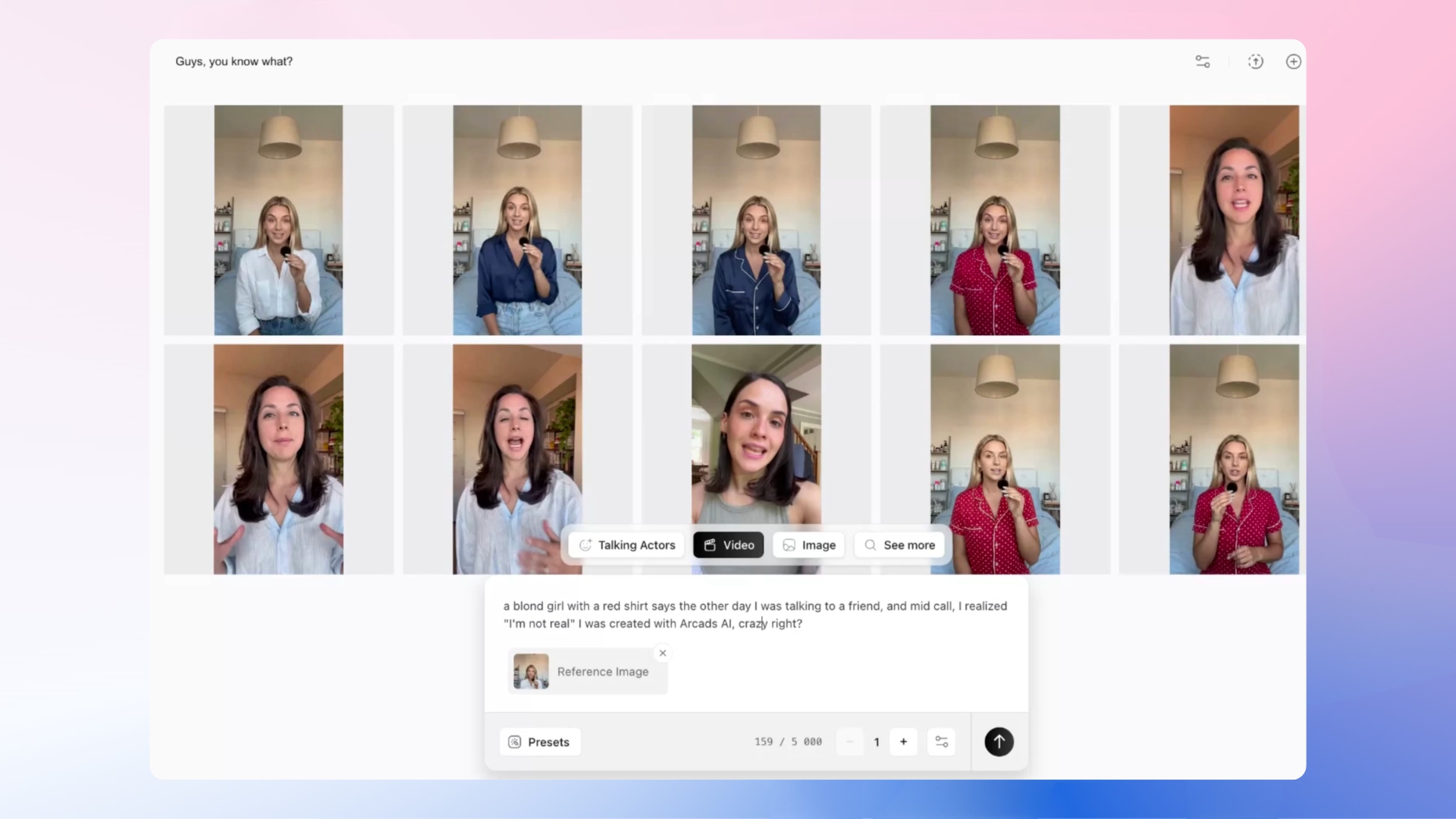
You can stand this up this week. Treat AI as the amplifier that multiplies your creative judgment, and keep your hands on the strategy.
- Define the persona for your ICP. Import a real image or prompt one that mirrors your ideal customer, so the face on screen matches the buyer you want.
- Write the script around a hook, an offer, and a clear call to action. The avatar delivers your angle, so your message still carries the weight.
- Generate variations in a single pass. Spin up multiple personas, accents, and languages from one script, then queue them for hook testing at scale.
- Push every variation to your ad platforms and read the data. Send them into Facebook, TikTok, and Google, and let real spend reveal the winning angle.
- Iterate on the winners. Apply the 70% rule, swap the character on a proven ad, and feed performance signals back into your next batch.
Two accelerants make this run faster. Build reusable workflows once in the node-based builder, or describe the workflow in plain language and let the AI agent assemble it for you. Power users go further and connect the Arcads API to Claude, generating videos through a simple chat interface. Each option lets you turn a manual process into a system that runs while you focus on strategy.
Measurement keeps this honest. Track three numbers as you scale: ROAS on each angle, blended CAC across the account, and the win-rate of new variations against your control. Those signals show which personas and hooks deserve more budget, and they turn creative volume into a decision you can defend to your board.
Fit matters too. AI avatar ads reward teams that value output and rapid iteration, which makes them a strong match for performance-driven funnels and high-volume testing. Keep brand trust in view as you scale: stay accurate in your claims, follow the disclosure rules in each market, and brands built on long-term creator relationships can phase the approach into part of the mix while they learn what resonates.
Turn creative volume into a pipeline that compounds
The lesson from Romain's playbook is bigger than any single tool. When creative volume becomes cheap and fast, the brands that win are the ones who treat content as a system, feed it into distribution, and convert that distribution into pipeline, the way a content-led funnel that runs on zero ad spend does. AI avatar ads give you the volume. Your judgment on hooks, offers, and audiences gives that volume direction.
That combination is exactly what Edbound AI was built to support. When you treat your insights, your podcast, and your customer stories as fuel for content at scale, you stay consistent through every quarter while your team protects its energy for the work that moves revenue. Build the system once, run it every week, and let execution at scale carry your pipeline forward.